By Patrick R. Dunn. WSET Level 3, former National Park Service interpretive ranger, author of Stop Leading on Empty. Founder of Vianarra, a hospitality storytelling practice.
The First Bottle Is for Friends
Pour Story Society · Issue 1 · October 2, 2026 The First Bottle Is for Friends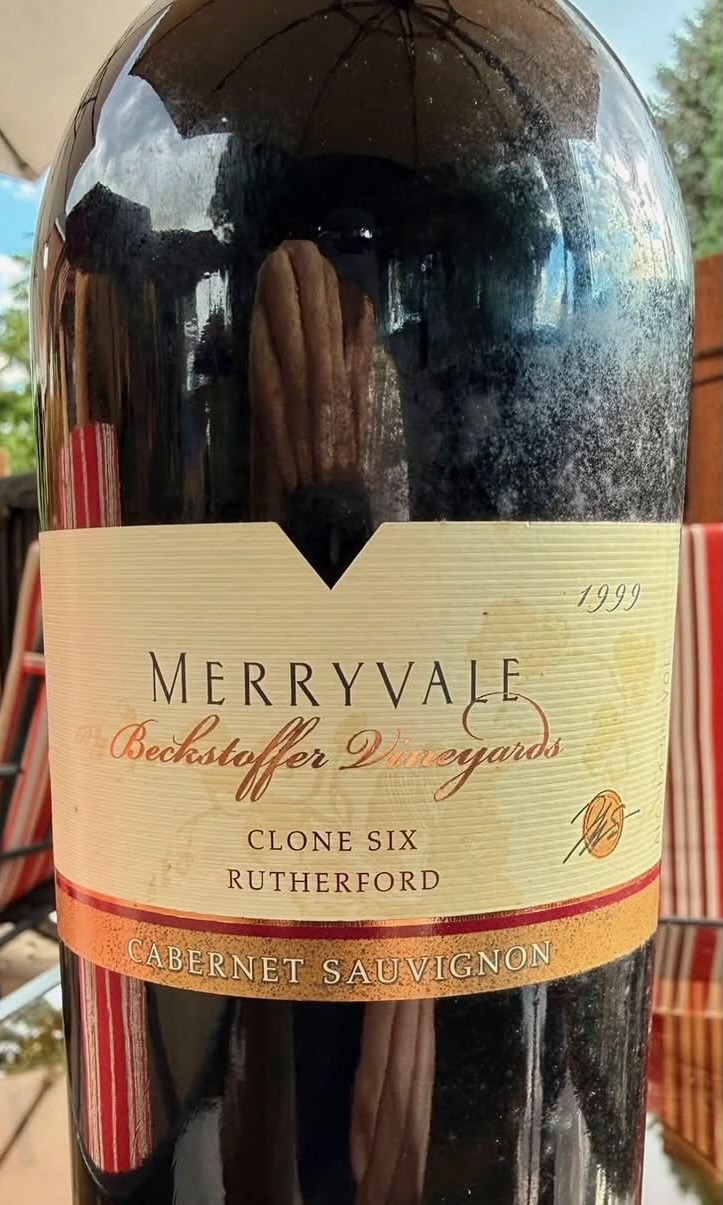
The 1999 Merryvale Mike carried in to Mo's by the River. On a Friday night this summer, the patio at Mo's by the River in Reno was starting to cool as the sun dropped behind the houses on Jones Street, and there was a pizza box open on the table. Mike had carried in a bottle, a 1999 Merryvale Cabernet from Andy Beckstoffer's Clone Six vineyard in Rutherford, twenty-seven years in the glass, and he poured some into mine without being asked before pouring Mo a splash and asking her to name it. She got the variety and the vintage, standing there with the patio filling up around her. There was tobacco under the fruit, and one swallow put me back at Sunday dinner on my grandparents' farm in West Gardiner, Maine, fifty-some years ago, with Gramps working on his pipe and Uncle Cliff on a cigar. I've always suspected Gram took a pipe herself when nobody was looking, though nobody in that family would ever have admitted it. For a few seconds I wasn't in Nevada at all. I was back at that table, in a farmhouse that was torn down more than thirty years ago on land that has long since been sold off, and I was there because a friend decided I ought to taste what he'd brought. 📖 issue one Welcome to the Pour Story SocietyThis is the first issue, and it's for anybody who loves wine, whether they make it, sell it, study it, or mostly just like what happens when somebody pulls a cork at a crowded table. This first one is about friends, and the ways people find each other: a new face at a gathering, a stranger at the next table, somebody who walks up and says there's a person you ought to meet. It visits a wine group that started in Healdsburg and was rebuilt in Reno, a wine bar where the regulars answer to television nicknames, and a winery in Dry Creek Valley named for friendship. One woman runs through the first two, and she's the reason for the toast at the end.
🥂 wine groups The Wine Divas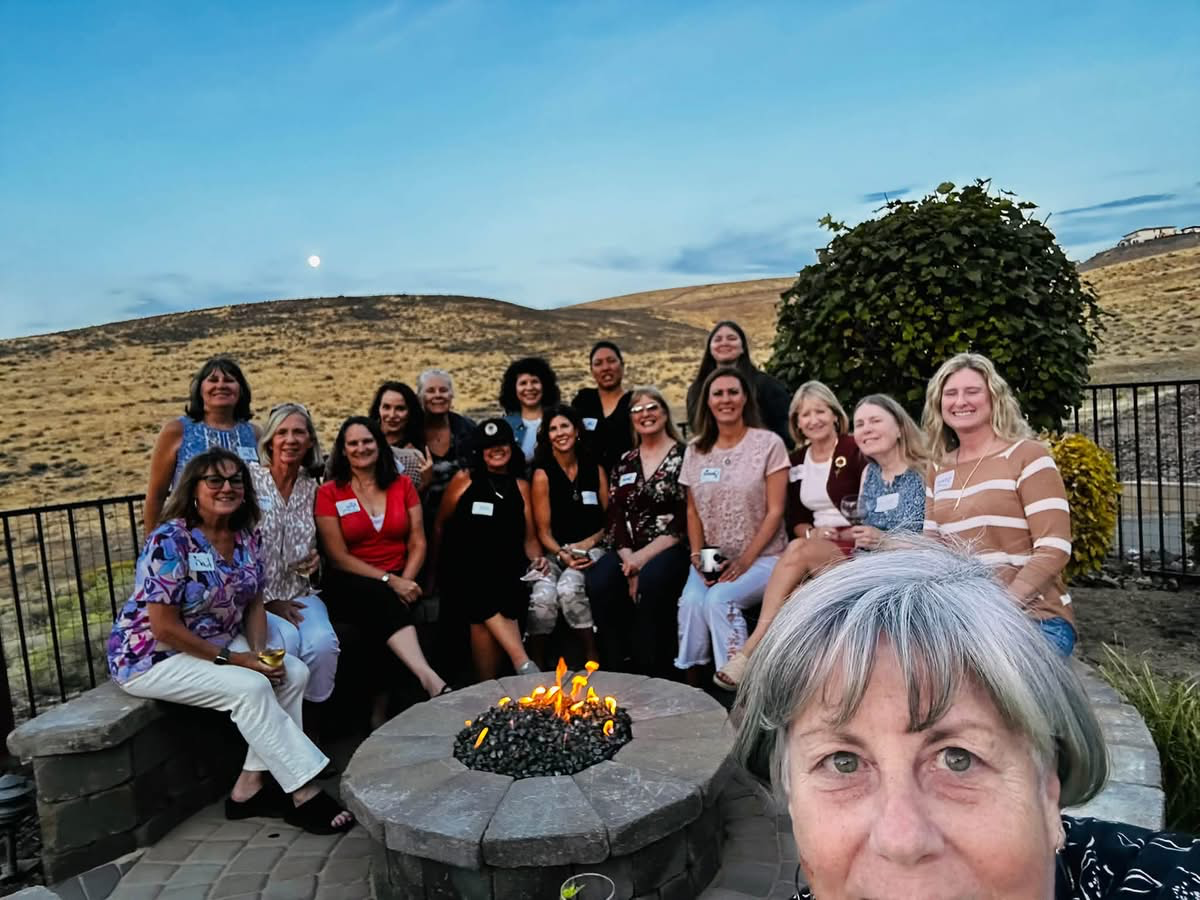
The Reno Wine Divas around the fire pit on a September evening, with the moon coming up over the hills. Selfie by Kathi Brown. When Lori and I lived in Windsor, she was invited into a group of women in Healdsburg who called themselves the Wine Divas, and since she was new to wine country, she said yes because she wanted to meet people. The rules were simple. Everyone brings a bottle of her favorite wine and an appetizer to share, along with her own glass, so the host doesn't spend the end of the night washing a dozen of them. That last rule is the thoughtful one. It means the woman who opened her house gets to stay in the conversation instead of standing at the sink. Most of the Healdsburg women were retired and had the time to take the appetizers seriously, and some of them started cooking in the morning. They took Lori in, and years later many of them are still friends. When the move to Reno came, Lori was the new one in town all over again. She went looking for a wine group to join, and when she couldn't find one she started her own, keeping the name and the rules, with six women at the first gathering. They meet once a month now, sometimes in somebody's house and sometimes at a local wine bar, and the table looks different from the one in Healdsburg. Most of the Reno Divas still work, so the appetizers usually come from Safeway or Trader Joe's on the way over, and since a lot of them moved here from California, a bottle from the grocery aisle often sits next to something from a small California producer that somebody carried over the hill. Nobody checks which is which. Last Thursday it was Lori's turn to host. The Divas are ladies only, but Kathi Brown took the picture above, and it shows the evening: more than fifteen women on the back patio with name tags on and glasses in hand, gathered around the fire pit as the sun went down behind the hills and the moon came up over the sagebrush. Lori had made a shrimp appetizer from scratch. Two of the faces were new, a neighbor from down the street and a woman Lori had met at the rib cook-off a couple of weeks earlier and invited to come see what the group was about, and the name tags helped. One face was missing. Candy Greene, one of the Divas, died a few weeks ago, and before the night was over the women raised a glass to her. The Divas have turned into a way in for the husbands, too. Through Lori's group the couples have gotten to know each other, and more than a few friendships around town trace back to one of those nights. The husbands have noticed. A Wine Dudes club is now in formation, with a few rules of its own, starting with no grocery store wine and nothing under $25 a bottle at retail. Anyone in the Reno area who would like to know more about either group can reply to this email, and I'll pass the Divas notes along to Lori. 🍷 wine bars Mo's by the River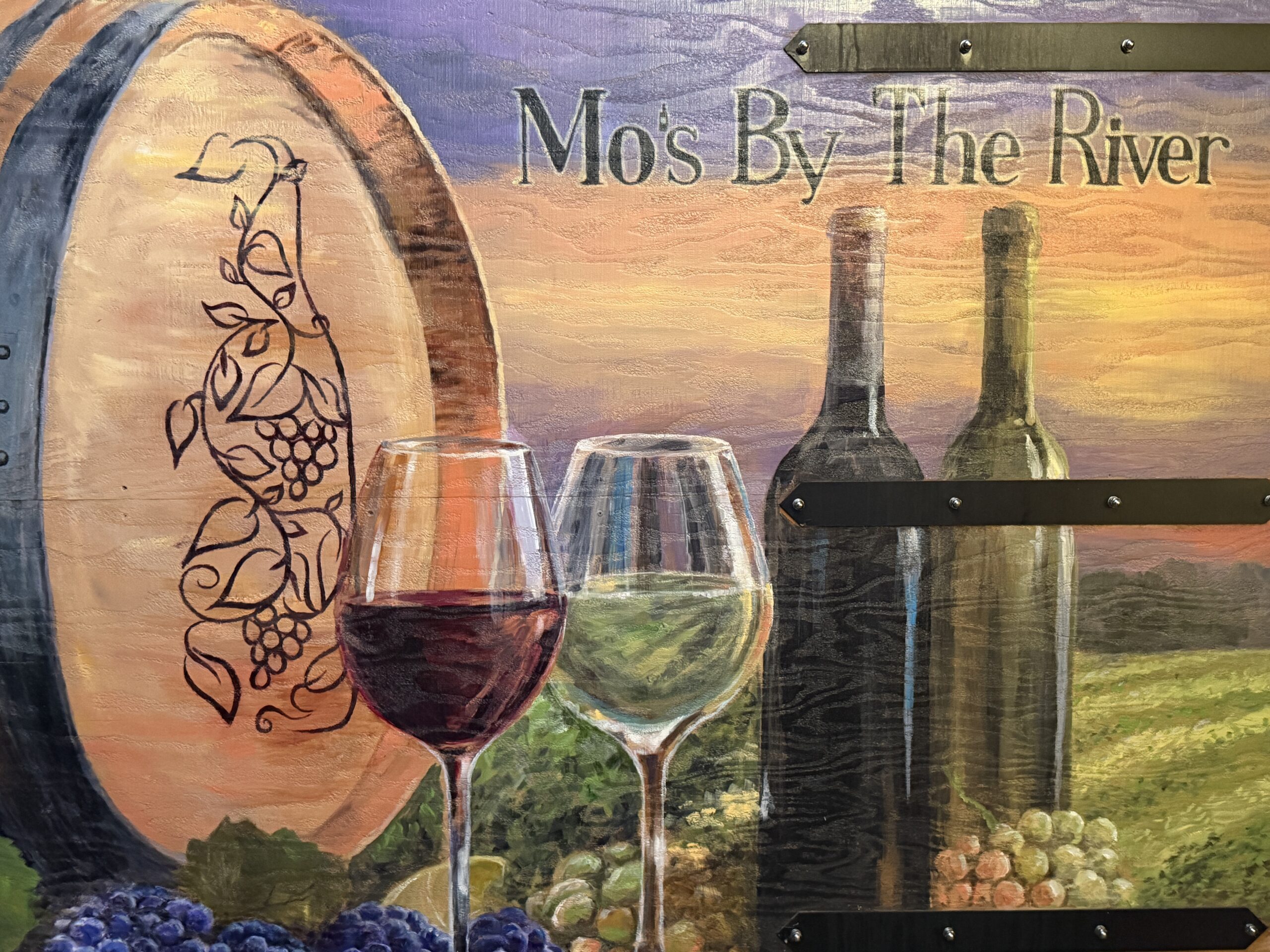
The sign at Mo's by the River. Plenty of other Reno friendships started at Mo's by the River, which the regulars think of as their Cheers bar, after the Boston bar on television where Sam poured, Carla worked the room, Norm got his name hollered at the door, and Frasier tried to explain everybody to themselves. Mo's is a small wine bar in an old 1940s garage in Reno's Powning District, a short walk from the Truckee, and Mo is its Sam. She greets everybody the same way, whether it's the regular who was in last week or a stranger coming through the door for the first time, and after a few visits she knows what a person likes well enough to hand them something they'd never have picked for themselves. Every winter she closes for a stretch and goes to France and Italy to taste with producers and choose what she'll pour the following year, so most of what's on her shelves is wine nobody in Reno has heard of. There's no kitchen, which means people bring their own food, and the wine groups bring their own bottles and pay corkage. The wine is good, and the people are why the regulars keep coming back. Almost all of them have picked up a Cheers name along the way. Mike is the Norm, and he never comes in empty-handed; he brings an older Cabernet to share and a story to go with it, which is how that Merryvale ended up on the table. Mine is Frasier, and the reader can decide whether that's fair. The Carla was Candy Greene, the same Candy the Divas toasted on Thursday. She seemed to know half of Reno and loved nothing better than introducing people, usually with a glass of bubbles in her hand, and if there was somebody at Mo's she didn't know, she fixed that and then walked them over to somebody she thought they ought to meet. A good many friendships around that room started with Candy, and she's also the one who brought me into Senior ResQ Magazine, where I write a monthly wine column. Mo's isn't the same without her. 🍇 wineries Amista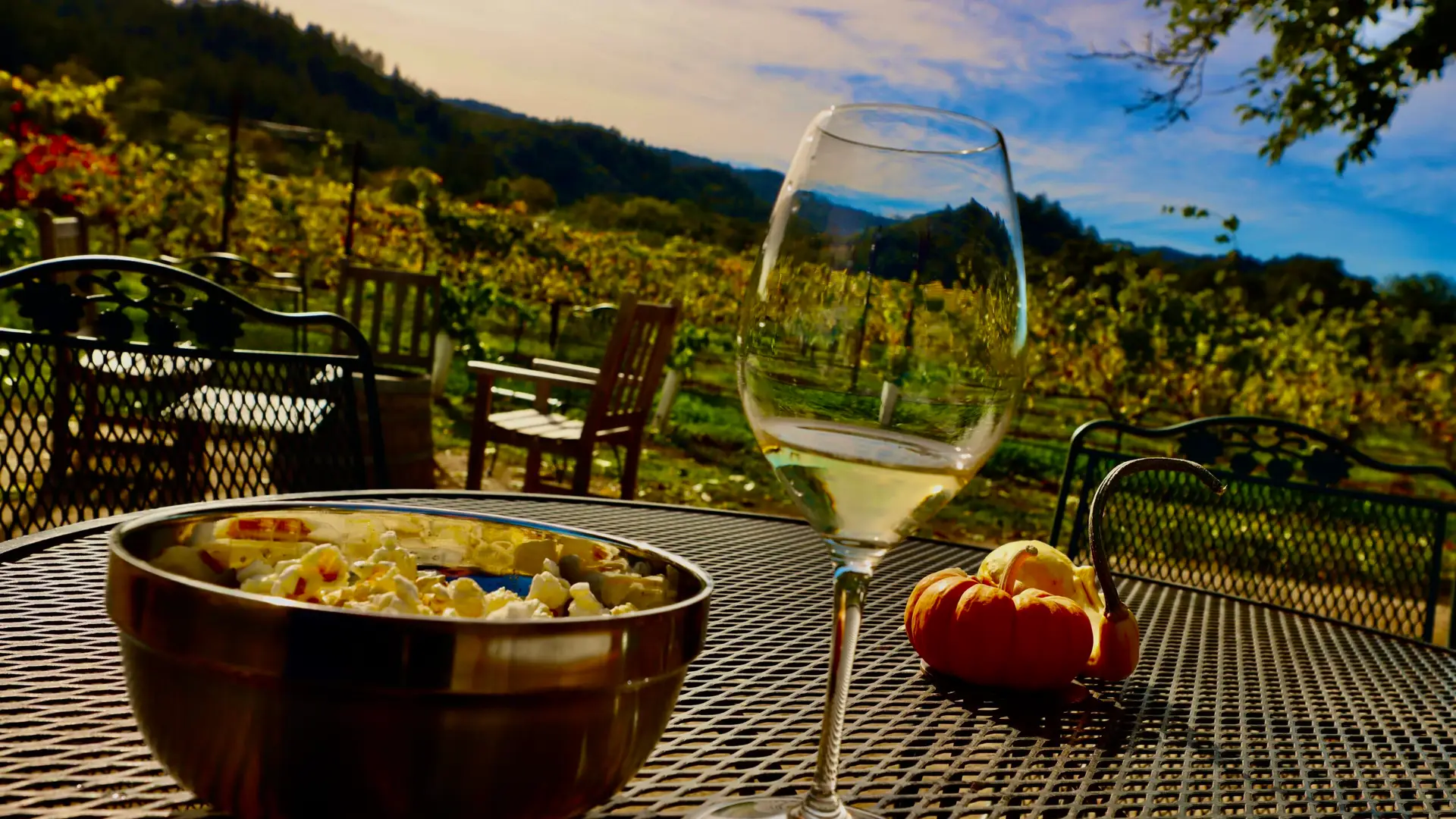
The popcorn at Amista, with the vineyard behind it. Amista is where the idea for this issue started, on an afternoon when Lori and I were the new faces. It was August of 2020 and it was hot, the kind of Dry Creek afternoon where the light comes up off the gravel and the hills go pale by two o'clock, and the Walbridge fire was still burning in the hills west of Healdsburg. Tastings had only recently been allowed back, outdoors and spread apart, and after months of staying home everybody was still relearning how to be around strangers. We were in the Adirondack chairs behind the tasting room at Amista Vineyards, facing the fields that run toward the Russian River, when our host brought out a bowl of the seasoned popcorn Amista puts in front of everyone who comes through. She refilled it once without being asked. Ron and Leslie were sitting a few feet away, and nobody remembers now who spoke first. The conversation started the way conversations start when nobody is working at it, and it didn't stop, so by the end of the afternoon the four of us had a plan: up the road to Saini, over to Mauritson, and then dinner together. Six years later they're still our friends. I joined the wine club that afternoon without getting out of that chair. It was my first wine club and it's still the one the others get measured against, and the favorite was their Rockpile Cabernet, which they don't make anymore and which I still miss. The winery itself was built on friends. In 1994 Mike Farrow planted 150 vines at the house he and Vicky had in Saratoga to solve a landscaping problem, and before long he was making wine in the garage. When Vicky took a job in New Jersey they had to leave the vines behind, but they took a barrel of Mike's wine with them and poured it for friends, who kept raving about the wine from the magic barrel. Five years later the Farrows found the property in Dry Creek Valley, and in 2004 they founded Amista. The name comes from Spanish and loosely means making friends, and Vicky says it came from those friends who'd been cheering them on all along. It doesn't hurt that it puts them first on any alphabetical list, either. On the winery's story page, the two of them wrote that wine is "a source of endless discovery and rich friendships." These days Amista is best known for its sparkling wines, made in the traditional method, though it still makes Rhône-style still wines too, all from organically certified grapes, with Ashley Herzberg as winemaker. For years Mike turned up at the winery's Sparkling Soirée in a tuxedo and a top hat, and one afternoon I watched him and Vicky walk through their vineyard holding hands. Mike died in December of 2023, at 80. Vicky runs the winery now, and the popcorn still comes out with the first pour. 🍾 the bottle This Issue's Bottle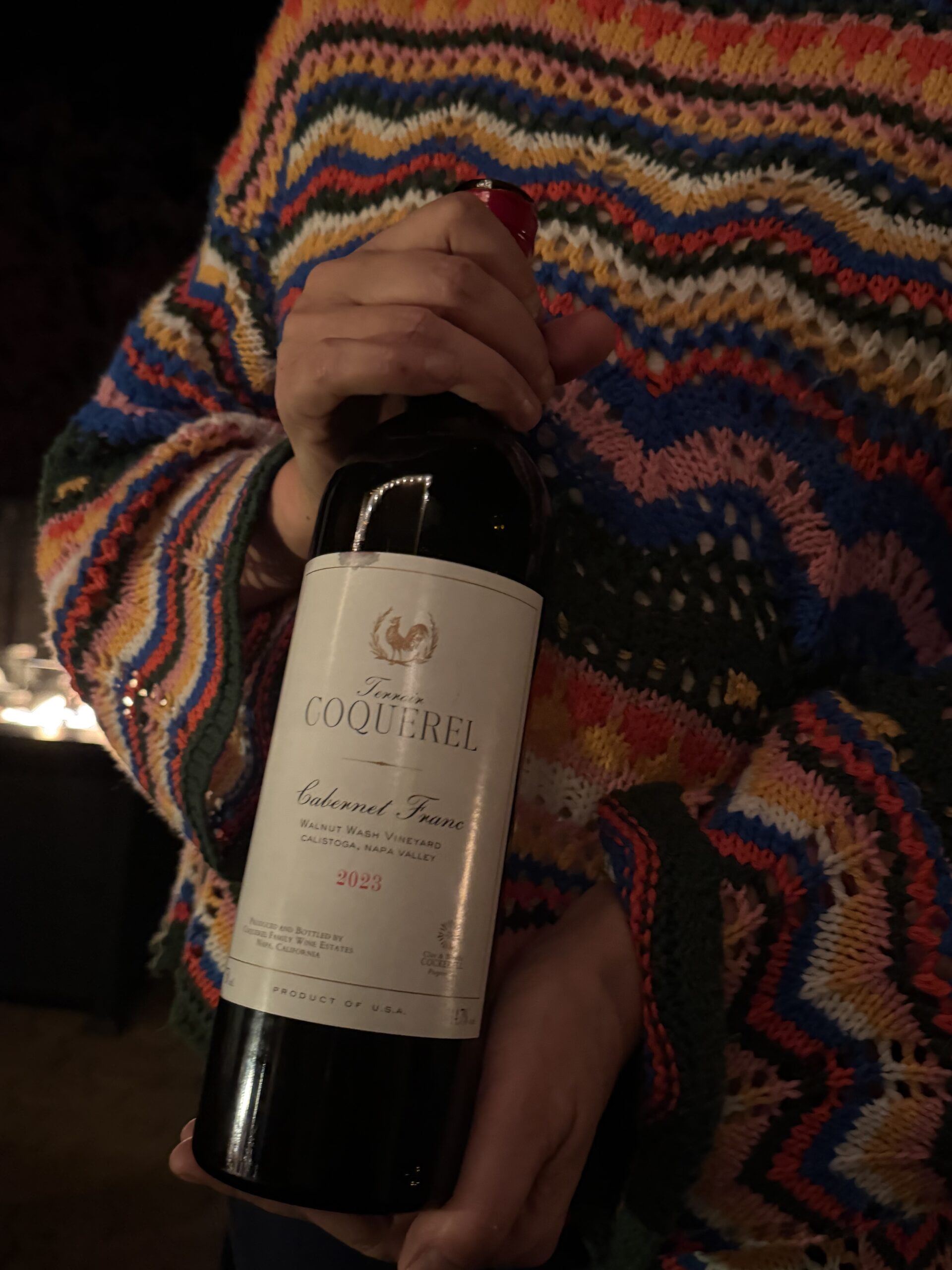
Mo with the Terroir Coquerel 2023 Cabernet Franc at a food pairing night at Mo's by the River.
This one came from a friend too. That's Mo holding it, back at Mo's during one of her food pairing nights, and that's how a lot of good bottles find their way around Reno: a friend opens one for a room full of friends. It's one of the smoothest Cabernet Francs I've tasted in a while, and the first sip took me straight back to Muir Woods, walking among the redwoods after a rain. I remember sitting there listening to the trees, and that time among them helped give my life some direction. Cabernet Franc is known for compounds called pyrazines, which give the grape a green, leafy edge, something like crushed tomato leaf, green bell pepper, or damp cedar, and that may be why this one put me back in that forest. There's a rooster on the label, and the rooster has a story. Clay Cockerell, a Dallas dermatologist, and his wife Brenda were longtime wine collectors until an anniversary trip to Bordeaux convinced them to start making wine of their own. When it came time to name the winery they kept the family name but gave it an older French spelling, Coquerel, which is why the front of the label says Coquerel while the small print in the corner credits Clay and Brenda Cockerell. In plain English, a cockerel is a young rooster. In 2005 they bought a vineyard just outside Calistoga, at the warm north end of Napa Valley, and three years later added the site next door. Together the two became Walnut Wash, where the Mayacamas Mountains throw the vines into shade by late afternoon and the Cabernet Franc went in in 2015. Their winemaker, Christine Barbe, grew up in Bordeaux, trained at the Bordeaux Institute of Enology, and came to California in 1996. Cabernet Franc has been growing in Napa since at least 1885, when Hamilton Crabb of the To Kalon vineyard and other growers planted it hoping to make claret like Bordeaux. It's also one of the two parents of Cabernet Sauvignon, along with Sauvignon Blanc, so at Walnut Wash, where all three grow on the same few acres, the parents and the child come off the same ground. This time the bottle was poured by a friend. 🗺️ coming up What's ComingThe Pour Story Society comes out every other Friday. Wine country reaches well beyond California, and California's reaches well beyond Napa and Sonoma, so the stories will come from Amador County and Temecula, Washington State, Texas and New York, Italy and France, Croatia and the country of Georgia, and from unique places anywhere else in the world. Some issues will follow one odd bottle back to the ground it grew in. Others will step outside the glass to a boutique hotel or a one-of-a-kind restaurant, the kinds of places that turn a trip into one people talk about for years, and now and then there will be a few wine basics for people just getting started. Meet the Winemakers The Meet the Winemakers conversations work the way friends talk. They start with where a winemaker grew up and what their folks did and how they ended up in a vineyard, and only then get around to what's in the bottle. It's the folklore fieldwork method of Sandy Ives, whom I studied under at the University of Maine. The conversations will come from California and from wine regions around the world, recorded and written up from the transcripts so the words are the winemaker's own. 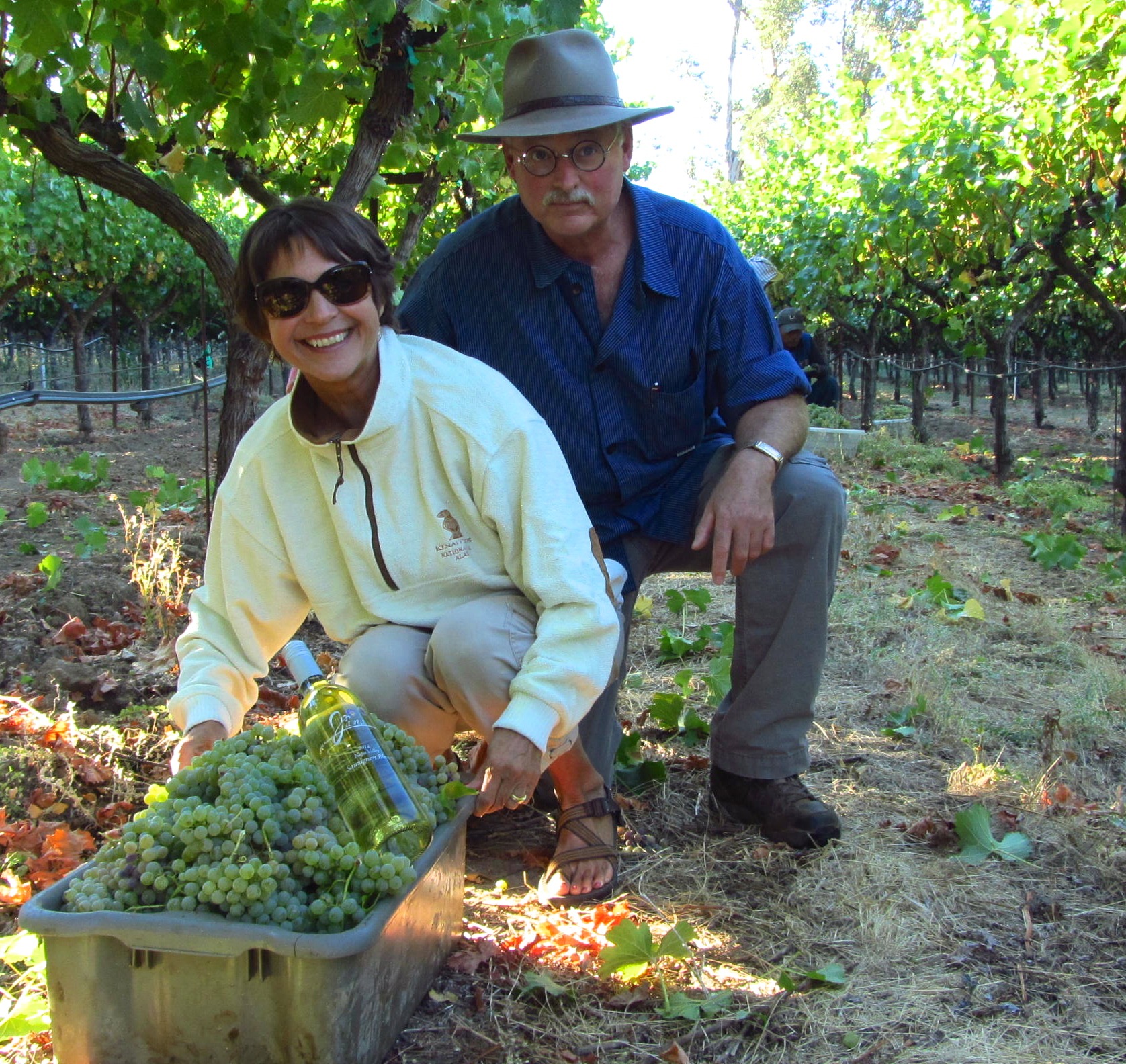
Scott and Jana Harvey of Scott Harvey Wines, Amador County. The first one is with Scott Harvey of Scott Harvey Wines in Amador County, recorded on the last day of his 53rd harvest. Asked what has changed in the trade since he started, he went back to his grandfather's vineyard:
Read the full conversation with Scott Harvey
That's the first issue. The Divas raised a glass to Candy on Thursday, and the Pour Story Society raises one here too. If somebody came to mind while reading, send it their way. Patrick Sources: Amista Vineyards; Wine Road Podcast; Sonoma County Winegrowers, "The Good Stuff," Episode 49; Sonoma State University Wine Business Institute; Coquerel Family Wine Estates; D Magazine; Santa Clara University Women Winemakers profile of Christine Barbe.
|
Vianarra: Hospitality Storytelling for Wineries, Hotels, and Restaurants
By Patrick R. Dunn. WSET Level 3, former National Park Service interpretive ranger, author of Stop Leading on Empty. Founder of Vianarra, a hospitality storytelling practice.
Vianarra · Issue #19 · September 30, 2026 The Man Hosing Out the Bins They came in a little after two on a Saturday in late September, the part of the year when flatbeds stacked with bins of picked fruit share the two-lane roads with rental cars and every winery on the road smells faintly of fruit turning into wine. It was their third stop of the day, and they had reached the point where the flights and the friendly faces behind the counters start to run together, and they had nearly driven...
VIANARRA Issue #18 · September 23, 2026 The story found along the way Please Visit Our Website By Patrick R. Dunn What came in the mail I joined a new wine club recently. The welcome email arrived the same day. It said I was receiving it because I had just become a member, gave the name of my membership level, and asked me to visit the winery's website. It was signed by the corporation. That was the welcome. I belong to more clubs than I should, and this season I went back through what they...
A hospitality storytelling newsletter for winery owners, winemakers, tasting room managers, boutique hotels, inns, and independent restaurants, about the story a property already has. The owner was at the bar Issue #17 · Wednesday, September 16, 2026 Bacigalupi 65th Anniversary Goddard Ranch Pinot Noir, carried in to La Famiglia, Reno. Somewhere in the first half hour our server mentioned that the owner was from Maine, which in Reno is not a small piece of information. I grew up in West...